Why You’re Busy… But Still Not Growing
TLDR
If you’re working nonstop but your revenue isn’t reflecting your effort, the problem isn’t your work ethic. It’s misalignment. Taking every job, underpricing your services, running disorganized systems, and relying solely on referrals can keep you busy but prevent real growth. Sustainable progress comes from tightening your pricing, refining your systems, being selective about the work you accept, and building consistent online visibility so your business doesn’t depend on chance.
The Real Reason You Feel Stuck
You’re working 60 to 70 hours a week. You’re accepting almost every job that comes through the door. You’re doing the consultations, answering calls, managing payroll, solving problems, and carrying the weight of every major decision. From the outside, it probably looks like success. From the inside, it feels exhausting. And when you look at your bank account at the end of the month, it does not reflect the level of effort you’re putting in.
That disconnect is something many small service-based business owners quietly wrestle with. You are doing all the things. You are putting in the hours. You are giving your full effort. But financially, it feels like you are treading water.
So what is getting lost in the mix?
When Effort and Revenue Stop Aligning
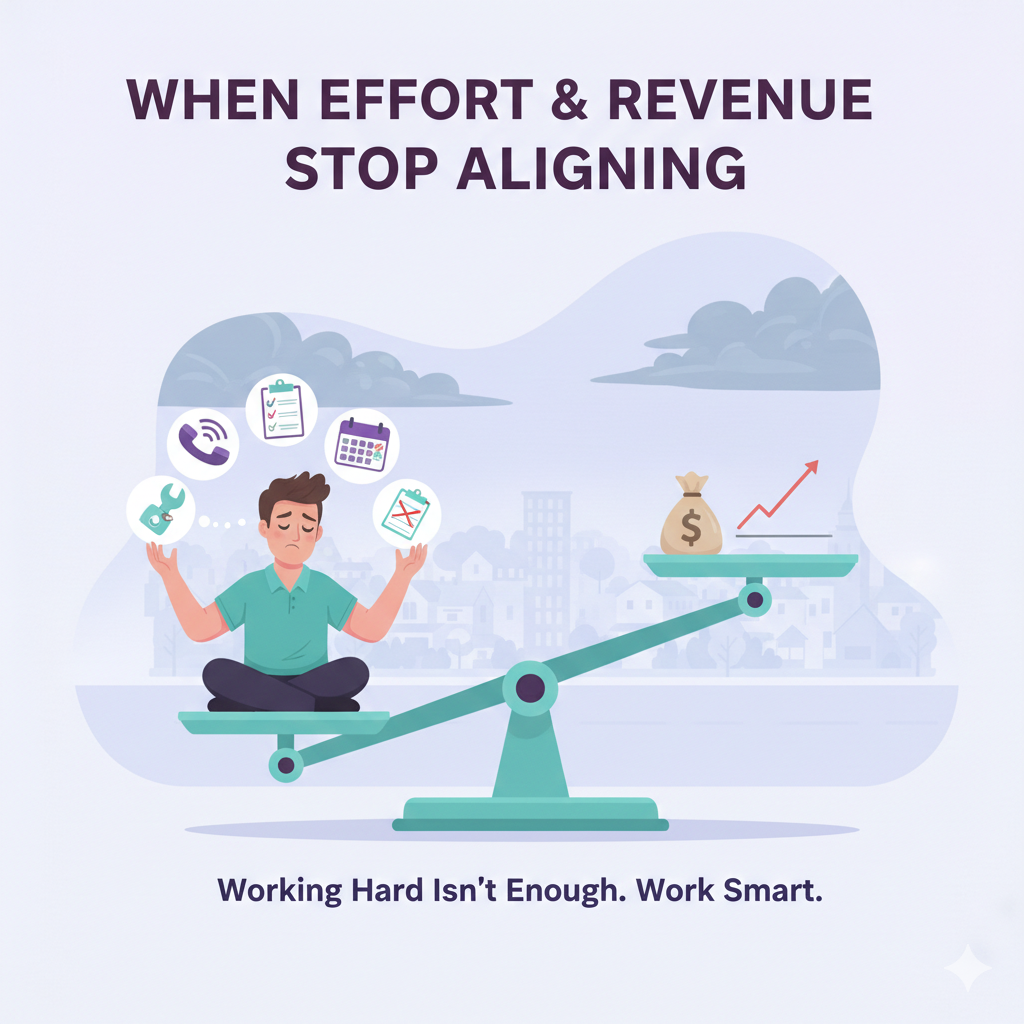
Most small business owners assume that more work equals more growth. If you take more jobs, stay longer hours, and say yes more often, revenue should naturally increase in a meaningful way. Sometimes it does. Often, it doesn’t.
Over time, especially under pressure, it is easy to lose sight of your core values and principles. You start stretching your services. You accept work outside your specialty. You become a jack of all trades. You tell yourself it is temporary, just until things stabilize.
Individually, those decisions feel reasonable. Collectively, they erode clarity and margin.
More jobs do not automatically mean more profit. If the work is underpriced, inefficient, or inconsistent, you are simply multiplying effort without multiplying return.
The Hidden Cost of Underpricing
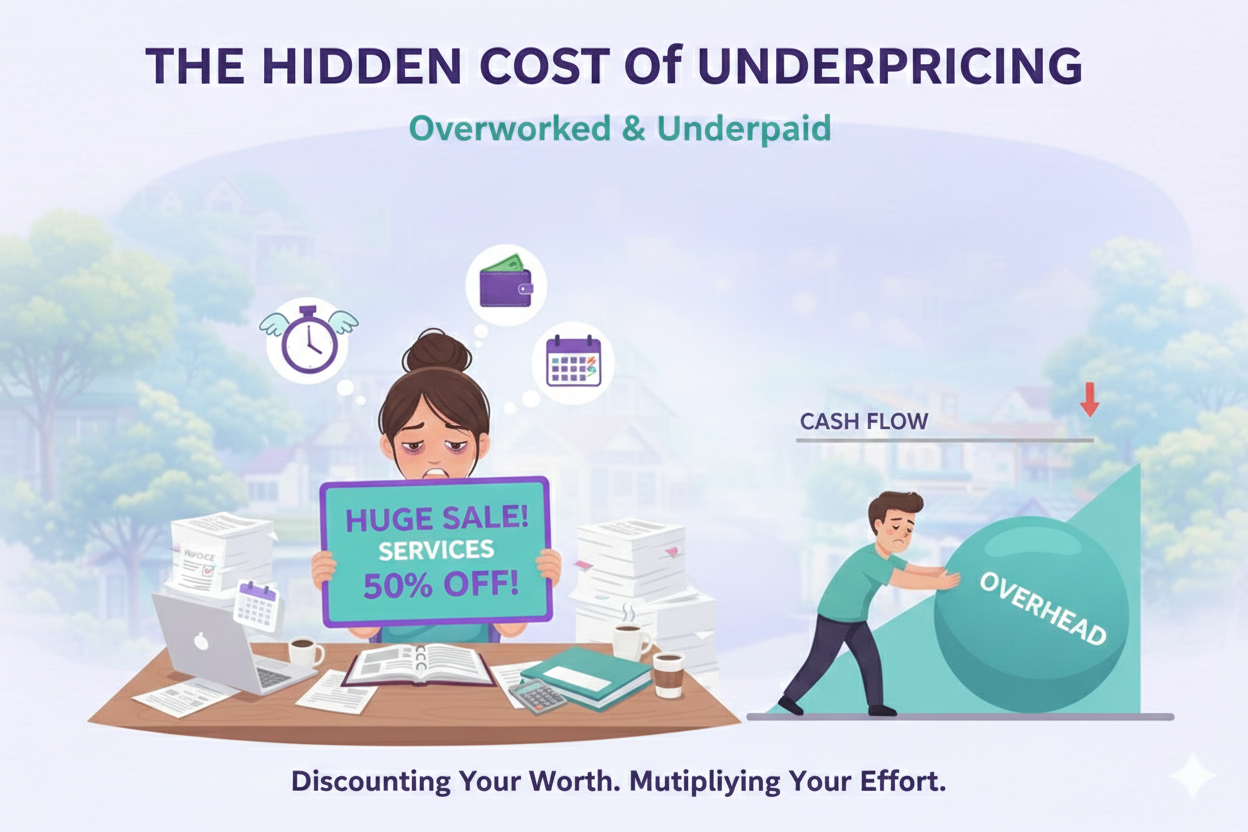
Pricing is one of the most difficult conversations small business owners have with themselves. Especially in an uncertain economy, raising prices can feel risky. You do not want to scare customers away. You do not want to lose the people who helped you grow. So you discount. You run sales. You keep rates lower than market value to stay competitive.
But constant discounting kills your margins.
When you repeatedly lower your pricing to gain visibility or win jobs, you limit your ability to invest back into the business. You shrink your profit per job. You train your customer base to expect lower pricing. Eventually, that decision catches up to you.
Healthy pricing is not about greed. It is about sustainability. If your pricing does not support overhead, payroll, reinvestment, and personal stability, then the business cannot grow in a meaningful way.
Taking Every Job Creates Chaos
When revenue feels uncertain, it is natural to say yes to everything. Every inquiry feels like an opportunity you cannot afford to lose. But taking every job creates inefficiency.
Without continuity, you cannot streamline processes. Every estimate requires a different approach. Every project feels slightly outside your rhythm. Your quoting becomes inconsistent. Administrative work increases. There is no refinement, only reaction.
Instead of scaling a business, you are scaling chaos.
And because your time is finite, you eventually hit a wall. Not just professionally, but personally. Burnout becomes real. Fatigue sets in. The business you once felt excited about begins to feel heavy. Work becomes something you endure rather than something you are proud to build.
Survival Mode Is Not a Strategy
When you are operating in survival mode, you are focused on making it through the next payroll cycle or the next slow season. You rely heavily on referrals. You do not have a predictable lead flow. Marketing feels overwhelming or unnecessary because you simply do not have the energy to add one more thing to your plate.
You also become the bottleneck in your own business. Every administrative decision runs through you. The mental load is constant. Even small decisions start to feel exhausting.
Survival mode keeps the doors open, but it does not create sustainable growth.
Growing Revenue Requires Stronger Systems
Revenue growth without system growth creates stress.
As you take on more work, your backend processes have to improve alongside it. That means knowing your cost per job. It means understanding your average ticket value. It means tightening your quoting and consultation systems. It means following up consistently with potential clients.
If your processes are disorganized, growth only magnifies inefficiency. You are not building scalability. You are building pressure.
Structure is what allows revenue to feel lighter instead of heavier.
The Visibility Gap

Many service businesses stay busy because of referrals. Referrals are valuable, but they are finite. If you are not intentionally building visibility beyond your referral circle, you are limiting your ceiling.
Ask yourself:
Do people find you when they search online?
Do you show up consistently across platforms?
Is your website clear and user-friendly?
Is your Google Business Profile accurate and active?
You can be busy with referrals and still be invisible to the broader market. If referrals slow down and you have not built online visibility, revenue becomes unpredictable very quickly.
Visibility is not about vanity. It is about stability. Consistency online builds trust signals, both for potential customers and for search engines. That trust translates into opportunity.
How to Realign Your Revenue With Your Effort
Fixing this disconnect does not require working more hours. It requires intentional shifts in how you operate your business. Growth becomes sustainable when your time, pricing, systems, and visibility work together instead of against you.
1. Become More Selective About the Work You Accept
Not every job is a good job. Focus on work that:
Aligns with your core expertise
Generates strong margins
Allows for repeatable systems
Fits the type of client you actually want to serve
Three well-priced, streamlined projects can often generate the same revenue as ten chaotic, underpriced ones, with far less stress.
2. Address Pricing Honestly
Evaluate whether your pricing reflects current market value, overhead, labor, and long-term growth. Sustainable pricing supports better service, better systems, and long-term stability.
3. Strengthen Your Backend Processes
Tighten your quoting system. Improve follow-up. Track your numbers. Create consistency wherever possible. Strong systems allow revenue to scale without multiplying chaos.
4. Build Predictable Visibility
Update your Google Business Profile. Ensure your information is accurate. Share recent photos. Repurpose content across platforms for consistency. Even small, consistent efforts build long-term search visibility and reduce dependence on referrals.
Growth Should Not Cost You Your Health
If you are constantly busy but never getting ahead, this is not about a lack of work ethic. It is not about failing, and it is certainly not about you not giving 100% effort. In most cases, the opposite is true.
You Are Likely Already Giving Everything You Have
You are carrying:
Long hours that stretch into nights and weekends
A constant mental load of decisions and responsibility
Problem-solving that never really shuts off
The pressure of payroll, clients, reputation, and stability
That level of effort is not the issue. Your commitment and your drive are not the issue.
The Real Issue Is Strategic Clarity
When revenue does not align with effort, it usually means your strategy, systems, and positioning need refinement. Something in the business's structure is preventing your hard work from compounding, instead of simply sustaining you week to week.
This is not a personal failure. It is a strategic misalignment.
Failure vs. Realignment
Failure suggests you are not doing enough. Realignment acknowledges that you are doing a great deal, but not all of it is working together efficiently. That distinction shifts the focus from self-blame to structural adjustment.
What Realignment Requires
Realignment means stepping back long enough to evaluate how you price your services, how selective you are with the work you accept, how consistently you build visibility, and how well your processes function behind the scenes. It is about using what you already have, your skill, your experience, and your reputation in a more intentional and sustainable way.
Growth should not require running yourself into the ground. It should come from tightening systems, clarifying focus, strengthening visibility, and making deliberate decisions that support long-term stability.
You are not behind. You are not incapable. You are not failing. You are likely one strategic shift away from alignment, and alignment is what allows your effort to finally translate into real progress.

Ready to Stop Surviving and Start Growing?
If this sounds familiar, you are not failing. You are likely operating without the strategic visibility and structure your business needs to scale.
At Found Local, we work with service-based businesses that are already working hard but need clearer positioning, stronger online visibility, and predictable lead flow. We help you show up consistently in search results, strengthen your Google presence, and build digital credibility that supports long-term growth.
You do not need to work more hours. You need a system that works with you instead of against you.
If you are ready to realign your effort with real results, contact Found Local today and schedule a strategy call.